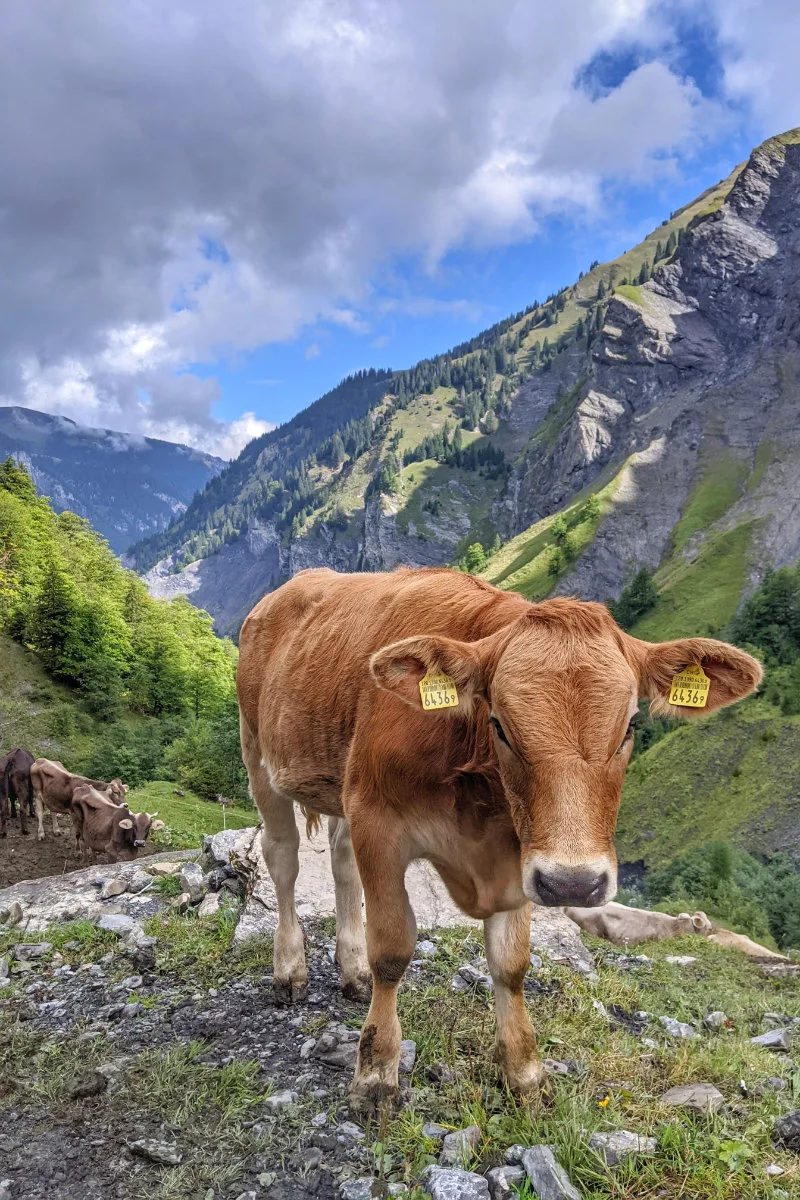
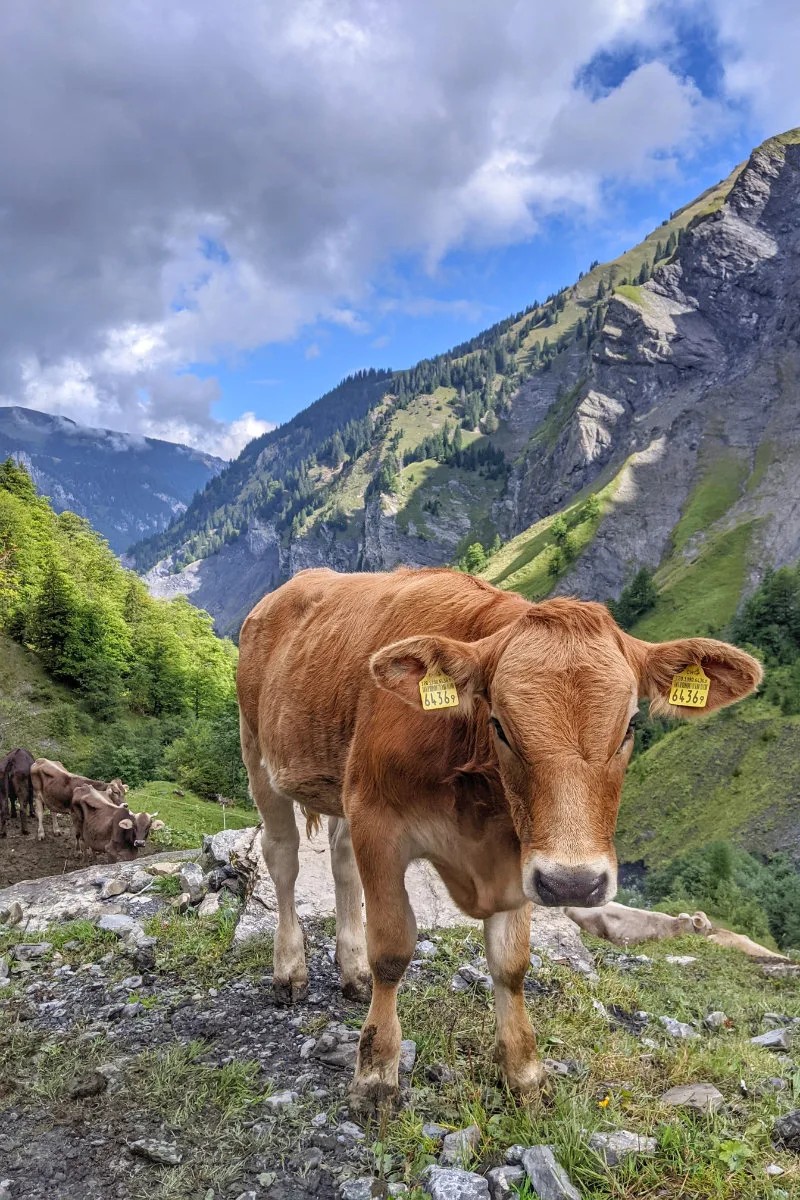
Hiking with a dog in Switzerland is inextricably linked to alpine meadows. However, encounters with herds of cows cause stress for many dog owners, including us. I asked the experts at the Advisory Office for Accident Prevention in Agriculture (BUL) how to read the cows’ body language and how to react correctly in an emergency.
The three zones: when does it get too much for the cow?
The BUL divides the space around a cow into three key zones. Understanding these zones can help prevent conflicts before they arise.
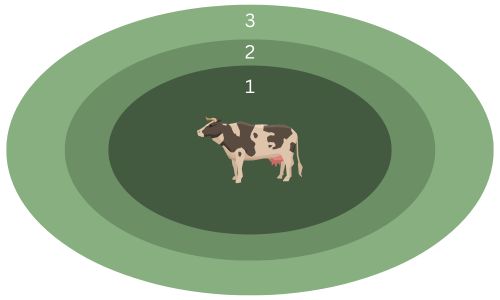
- Danger zone: You’re “too close.” The animal switches to defense mode; it will either attack or flee.
- Observation Zone: You are the focus. The animal is actively watching you.
- Awareness zone: The animal has you and your dog in its field of vision but is still relaxed.
Important: If cows have calves with them, these zones expand significantly. Any approach is perceived as a threat sooner.
Interpreting warning signs correctly
Before a cow snorts or bolts, she sends out subtle signals. Watch for these signs of distress in the herd:
- Body tension: Heightened alertness, head raised, and ears pricked forward
- Interruption: The animals stop eating or ruminating; those lying down stand up
- Protective reflex: Calves immediately seek out their mothers
Cows instinctively perceive every dog as a predator, no matter how small or well-trained it is.
“Cow etiquette” for dog owners
To ensure harmonious coexistence, the BUL recommends clear rules:
- Short leash: Keep your dog on a short leash so that it remains as inconspicuous as possible. Avoid using a long leash in the pasture.
- No contact: Never touch calves or adult animals, and do not feed them.
- Keep your distance: If you cannot maintain a safe distance, always choose an alternative route around the pasture.
- Cleanliness: Be sure to pick up dog waste and trash, and do not let your dog bathe in livestock watering troughs..
Special case: multi-dog owners & curiosity
If you have two or more dogs with you, the herd may become more agitated, as the cows have to watch out for multiple “predators” approaching from different directions at the same time (pack dynamics). In this situation, maintaining maximum distance is crucial.
We’ve had several instances where an entire herd of cows approached us out of sheer curiosity. If the herd approaches you out of sheer curiosity, the BUL advises a quick, calm retreat, as the mood can change suddenly.
A trick for dealing with intrusive animals: Throw an object (an umbrella or a piece of clothing) between you and the herd. Their curiosity is often briefly drawn to the object, giving you time to retreat.
The “worst-case scenario”: to let them off the leash or not?
The BUL takes a critical view of the old rule that “you should always let your dog off the leash immediately.” Often, a dog being chased seeks protection from its owner, which causes the agitated pack to head straight for the person. The primary goal must always be to maintain enough distance so that the pack does not enter into protective behavior in the first place.
Conclusion: guidance, not coercion
The most important advice from the pros: When entering a pasture, take a moment to get your bearings. Be prepared to turn back if in doubt, rather than forcing a dangerous situation. Safety always comes first.